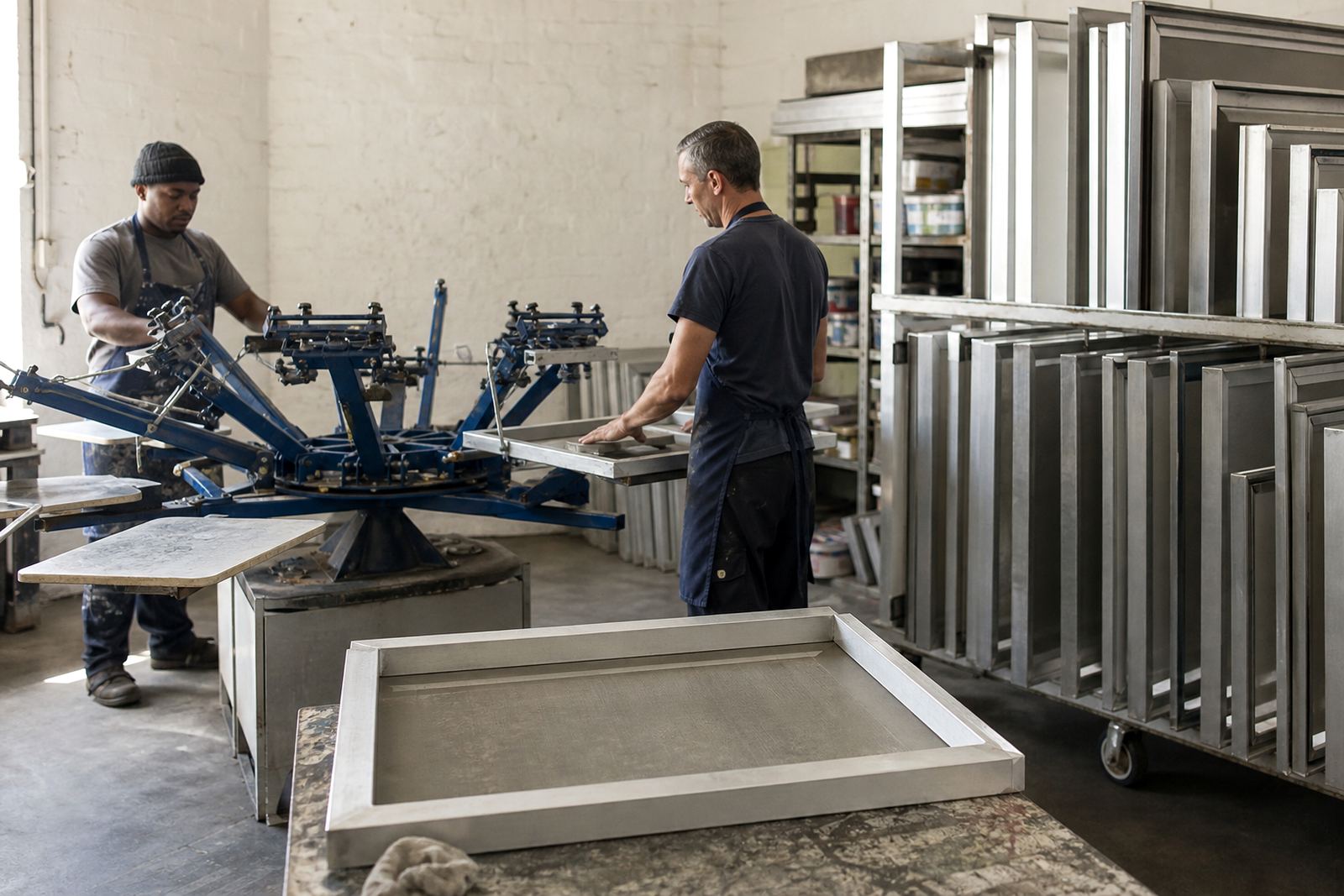


What school print clubs usually need from their frames
Most school print clubs are not running full production lines. They need a small, reliable set of frames that can handle repeated practice, short class periods and a mix of simple artwork like logos, slogans, numbers and basic two-colour designs. In that setting, frame weight, mesh tension and clean edges matter more than fancy extras.
For learners, the frame should be light enough to move safely between wash-up areas and print tables, but firm enough to keep registration steady. Aluminium frames are a practical choice because they handle regular use well and they do not swell like wood in humid coastal conditions. In Cape Town, Gqeberha or Durban, that helps when screens sit in a storeroom between sessions and the weather changes fast.
For school use, we often see clubs doing better with a small core set instead of too many sizes. That makes it easier for teachers or workshop supervisors to keep track of which screen is used for which task and avoids confusion during set-up.
A sensible starter set for learners and supervisors
A practical starter kit does not need to be large. Most school groups can begin with 4 to 8 frames, depending on class size and how many learners work at once. If the club is teaching basics, a few A4 and A3 equivalent frames are useful for posters, T-shirts and fabric bags. Larger frames are handy for group projects, but they need more storage space and more careful handling.
For a school print club in Johannesburg or Pretoria, where indoor space may be shared with other activities, a compact set can be easier to manage. In Cape Town and Durban, it also helps to keep the screens off the floor and away from damp corners. A simple rack, labelled storage slots and drying space for washed screens will save a lot of time.
- 2 small frames for practice sheets and test prints
- 2 medium frames for garment decoration work
- 1 or 2 larger frames for posters or class group designs
- One clearly marked frame for black ink only or one colour runs
- One spare frame for urgent replacement if a screen gets damaged
If the club is running weekly, it is worth having one frame set aside for learner mistakes and one for final work. That keeps production moving when a screen needs re-stretching or cleaning before the next session.
Planning the room so learners can work safely
Good planning makes the difference between a tidy print club and a messy one. The work area should have one section for artwork prep, one for coating or cleaning screens, one for printing and one for drying finished items. Even a small classroom can work if the stations are clearly marked. Supervision is important, especially where hot air tools, wash-down areas or sharp mesh edges are involved.
When space is limited, keep the frame sizes consistent. A mixed pile of odd sizes slows everything down because squeegees, platens and drying racks need constant adjustment. A fixed layout also helps learners understand the process step by step. It is much easier for a teacher to explain the sequence when the screens move in one direction only.
Good lighting is another simple win. Learners need to see mesh detail, stencil edges and ink coverage clearly. If the school has load-shedding, plan for sessions that can still run safely without relying on powered equipment. Natural drying time and hand-cleaning methods are often better for student groups anyway.
- Keep walkways clear so learners are not carrying wet screens through tight spaces
- Use labelled shelves for clean screens, used screens and repaired screens
- Place wash-up buckets close to the cleaning area, but away from finished prints
- Store ink and cleaning materials out of reach of unsupervised learners
Common mistakes in school print clubs
One common mistake is choosing frames that are too large for the learners to handle properly. Big screens can look impressive, but if the group cannot carry them safely or line them up accurately, the results suffer. Another mistake is using damaged or loose screens for teaching basic technique. Learners pick up bad habits quickly, and a slack mesh makes it harder to learn good pressure control.
Schools also sometimes try to stretch too many designs onto one frame. That saves time at first, but it creates cleaning issues and makes it hard to get clean registration. If a club is just starting out, keep each screen simple and single purpose. It is better to have 4 good screens than 10 mixed-up ones.
Another problem is poor storage. Screens left leaning against walls or stacked under heavy items can warp, especially in warm, humid areas. A damaged frame may still look fine at a glance but it will print unevenly. It is worth doing a quick inspection after each class for bent corners, mesh damage and loose glue lines.
Budget ranges for schools and learner workshops
School budgets vary, but it helps to think in stages. A small starter set for a club that meets once a week might begin in the region of R1 500 to R3 500 for a few frames, depending on size and quantity. A more complete setup for a larger school or a busy creative programme can move into the R4 000 to R9 000 range, especially if extra sizes and spare screens are included.
If the school wants to support regular garment decoration projects across terms, it makes sense to plan for replacement screens and a few extra frames each year. The cost is easier to manage when it is spread across terms instead of being left until a screen fails during a project deadline. For schools in the Western Cape, Gauteng and KwaZulu-Natal, transport and collection arrangements also affect the total spend, so it helps to group orders where possible.
For clubs on tighter budgets, the smartest approach is to start with the most-used sizes and add more only when the team has proven demand. That keeps stock under control and avoids money sitting in screens that are not being used.
- Starter club set: R1 500 to R3 500
- Growing school workshop set: R4 000 to R9 000
- Re-stretching or repairs: budget for regular upkeep instead of full replacement
- Bulk orders: best for schools sharing setup costs across multiple classes
How ScreenFrame supports school print clubs nationwide
Schools often need straight answers, clear lead times and frames that arrive ready for use. ScreenFrame works from Maitland, Cape Town and supports school print clubs, learner workshops and supervised creative sessions across South Africa, including Cape Town, Johannesburg, Durban, Pretoria and Gqeberha. We also help with Bellville collections and supply routes through Paarl where required.
Our team can assist with new screen stretching, restretching existing frames, mesh removal, frame cleaning, adhesive application, tension checks, frame inspections and custom size stretching. If a school is preparing for a project deadline, urgent turnarounds and pickup and return can help keep the club moving. We also give practical screen care advice, because a well-kept frame lasts much longer and performs better in classroom use.
For school print clubs, the best outcome is usually simple: choose the right sizes, keep the layout practical and use frames that can handle repeated learner work. That gives teachers fewer problems and gives students a cleaner result, every term.